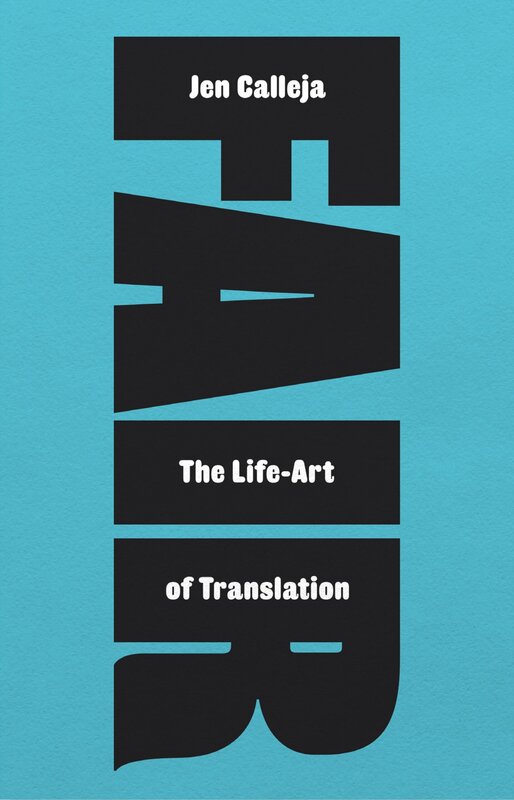
I found Fair at Super, a great independent bookstore in Copenhagen. It's a book with an interesting form: each chapter is a reference to a section in a fair, and the author Jen Calleja leads the audience through the many sections and exhibitions that more often than not pertain to her work, and the general art, of translation. Thus, it is as much a light memoir as a trove of practical advice for translating.
The book is highly entertaining and points towards many different directions. I learned about translation duels, and had a peek into the creative process of translating. I am more aware of the tension in translation, and mindful of the very precarious working conditions of this sector (and, on work, there is a beautiful passage that I almost transcribed in its entirety). The book is called Fair, after all – and that took me a while to notice!
There are a few sections that could very well be published on its own (and due to their structure, it could be the case that they started as blog posts, or essay-like publications): Q7 - feedbacks and complaints section is all about the kind of feedback translators (and Jen in particular) received, and The Ungeziefer in the Room refers to Kafka's Metamorphosis, commenting on another author's essay on the impossibility of translation, or general suspicion of the capability of the translator. All of the book is recommended, but if you can only leaf through it for a brief period, those are
Of all the pages and ideas that I highlighed for a later revisit, one stood out as being critically important to Calleja:
Not repeating sterotypes or sexist, racist, ableist, homophobic, transphobic language in a translation when it's not justifiable (when it's not, for instance, something said by a character with discriminatory views, or in a sarcastic tone or satirical mode, or when the writer is repeating experiences verbatim – and even these can be up for discussion depending on context and intended audience) isn't censorship – it's just mindful, responsive editing.
Even when translating my very first book, a non-fiction book for young people, I knew that it was bad writing when the author depicted a man seeking refuge using racist sterotypes and myths, and even though I knew nothing about what happens when translations are edited, I flagged it with the editor and said it shouldn't be in the translation. They agreed.
When we talk about women's safety, it's health and safety; when we talk about activist translation, we're really talking about good translation.
Throughout the book, one finds the argument for more visibility to the translator, more agency, and more recognition. There's examples on diving deep into a given author's work to uncover as many references as possible and do a good job at making those accessible to readers in another language; the impulse resistance I feel towards deliberately changing a work...especially if the argument rests on bad writing — why publish, then? But this is an active problem in the field.
Towards the end of the book, a most beautiful statement, and I bring it in full:
I'd like to open a Translation School, or the School of Adaptation. It would be like art school, or writing school, where any creative practitioner would not only understand from a place of creativity, but understand how creativity is a transformed energy, that it always comes from something else, from abstract ideas, from images and experiences, other people, and what that means in a creative sense, an ethical sense. Everyone would learn a language, everyone would read mostly texts about translation, everyone would make something in one form and then try and make it into another, a poem into a film, a text in one language into another language. A translation-led curriculum, taught by literary translators and adapters and audio-describers and screenwriters, translation, translation, translation. Everyone would go out into the world saying, 'it's like translation', with this dreamy look on their face, instead of or alongside, it's like music', 'it's like poetry'.
| Title | Fair |
|---|---|
| Author | Jen Calleja |
| Publisher | Prototype |